

Trailer ABC – B for Load
Arrive safely at your destination with the right load
When using a trailer, people often focus on hooking it up and driving. But safety isn’t limited to just that—it also depends on proper loading. Whether it’s yard waste, building materials, or your new motorcycle, how you distribute your cargo on the STEMA trailer determines driving stability, braking distance, and the wear and tear on your vehicle’s components.
Why weight distribution is key
A trailer loaded incorrectly does not have optimal road holding. It can start to sway and destabilize the combination. The golden rule is therefore: Heavy cargo should be placed directly over the axles or as close to them as possible.
-
Keep the center of gravity low: Place heavy objects as low as possible to lower the center of gravity and stabilize the vehicle.
-
Take advantage of the form-fit: Ideally, load the trailer so that the cargo rests against the side walls.
-
Even distribution: Prevents uneven loading, as this can place excessive strain on the axles and impair handling.
-
Bulk Material Tray: Always distribute sand, gravel, or leaves evenly across the surface. Caution: Wet cargo weighs significantly more than dry cargo—this can quickly lead to unintentional overloading!
The tongue weight
The tongue weight is the weight exerted by the trailer’s tow ball on the tow ball of the towing vehicle. Here, proper weight distribution determines whether the situation is safe or risky:
-
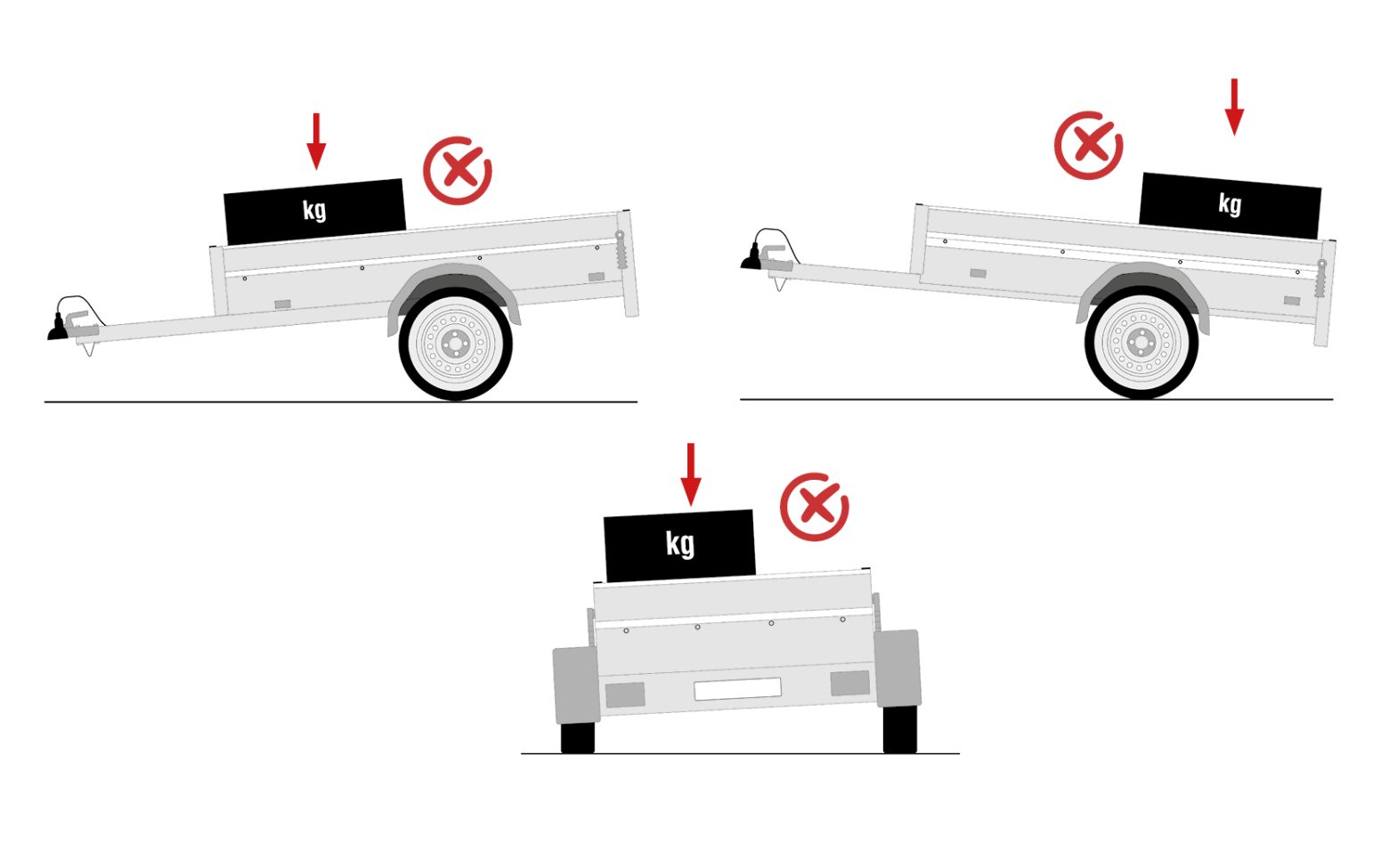
Insufficient tongue weight (rear-heavy load): If the load is positioned too far back on the cargo area, the rear axle of the towing vehicle is significantly relieved of weight, the tongue weight falls below the required level, and the vehicle may begin to sway even at low speeds.
-
Excessive tongue load (front-heavy): If too much weight is pressing down on the drawbar, the rear axle of the towing vehicle is subjected to excessive strain. This reduces steering responsiveness, increases braking distance, and causes your headlights to blind oncoming traffic.
Proper load distribution:
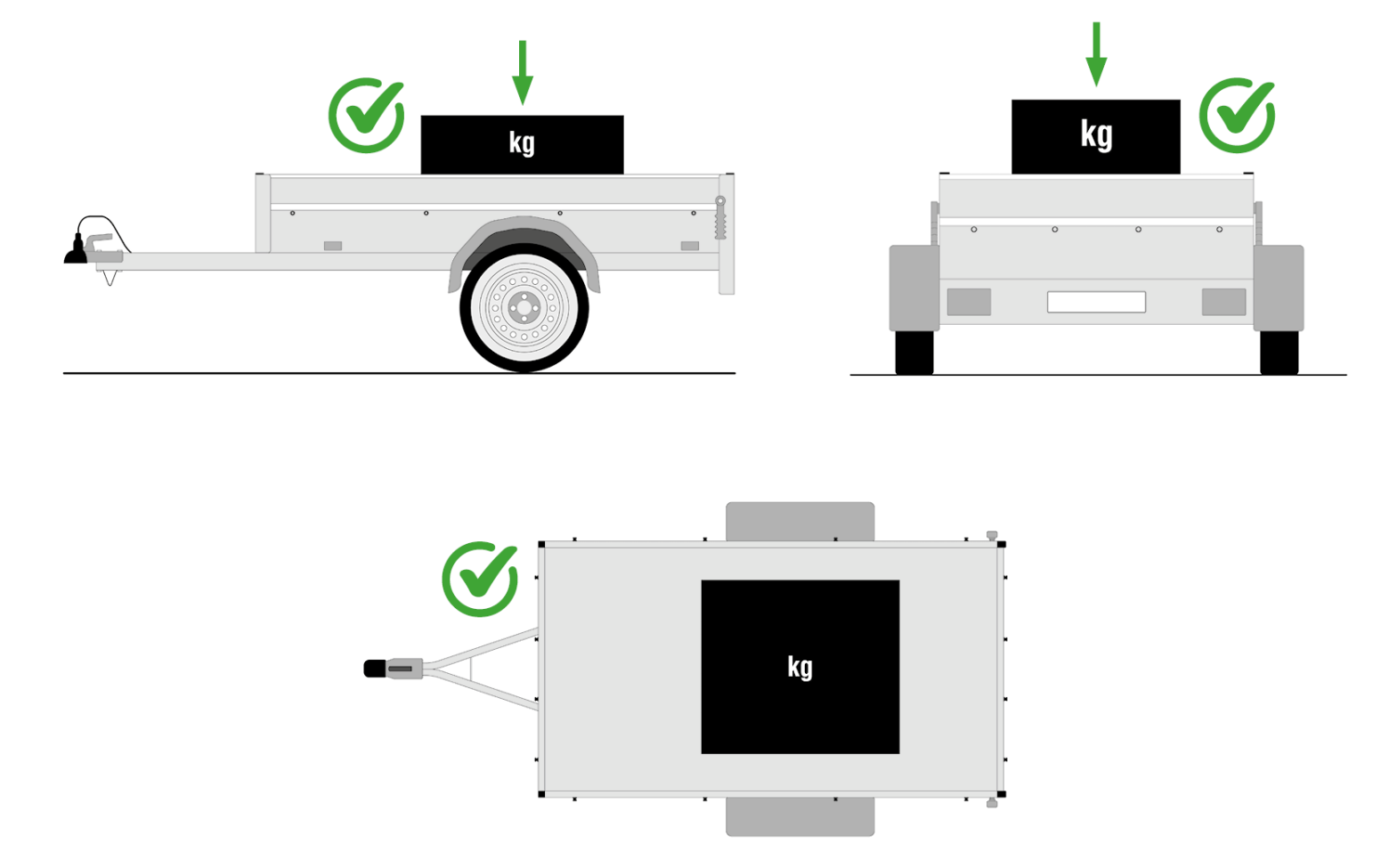
Ideal condition:
The center of gravity of the load is directly above the axle. The load is evenly distributed, so there is no uneven weight distribution. This ensures full braking effectiveness and optimal handling.
Incorrect load distribution:
Pro tip!
Use the maximum allowable tongue weight within the limits of what is technically feasible. You can find the maximum tongue weight on the nameplate or tongue weight label on your STEMA trailer.
Load Securing: Tight Doesn’t Always Mean Secure
Simply throwing a few straps loosely over the load isn’t enough. Even during an emergency stop at 50 km/h, objects can generate enormous forces.
- Use the tie-down points: Always use the built-in tie-down points on your STEMA trailer. Observe the maximum load capacity of the load-securing equipment and the tie-down points on the trailer. You can find this information on the load-securing equipment and on a blue sticker on the trailer.
Equipment Inspection:
Make sure the straps are secure, do not chafe, and are undamaged. The tie-down points on the trailer may only be used if they are in perfect condition.
- Special case: Overhang. Cargo protruding to the rear must not obscure the trailer‘s lights. The rear panel may be removed for this purpose, but must never be folded down while the vehicle is in motion!
Pre-departure checklist:
Before you start driving the trailer, quickly go over these points:
-
Is the gross vehicle weight (trailer + load) within the limit?
-
Is the tongue weight within the safe range?
-
Are all loose items (e.g., sand or leaves) secured with a net or tarp?
-
Are the tie-down straps tightened and capable of withstanding the maximum forces?
With the right load, you’ll not only be safe but also relaxed on the road. Because a STEMA trailer performs best when you push it to its limits—but with a smart approach!
Newsletter & Contact

Subscribe to the STEMA newsletter.
Subscribe to the STEMA newsletter and get news and special offers emailed directly to you.
- Linda Pilot
- Marketing & PR
- Riesaer Straße 50
- 01558 Großenhain
- T +49 3522 30 94 94